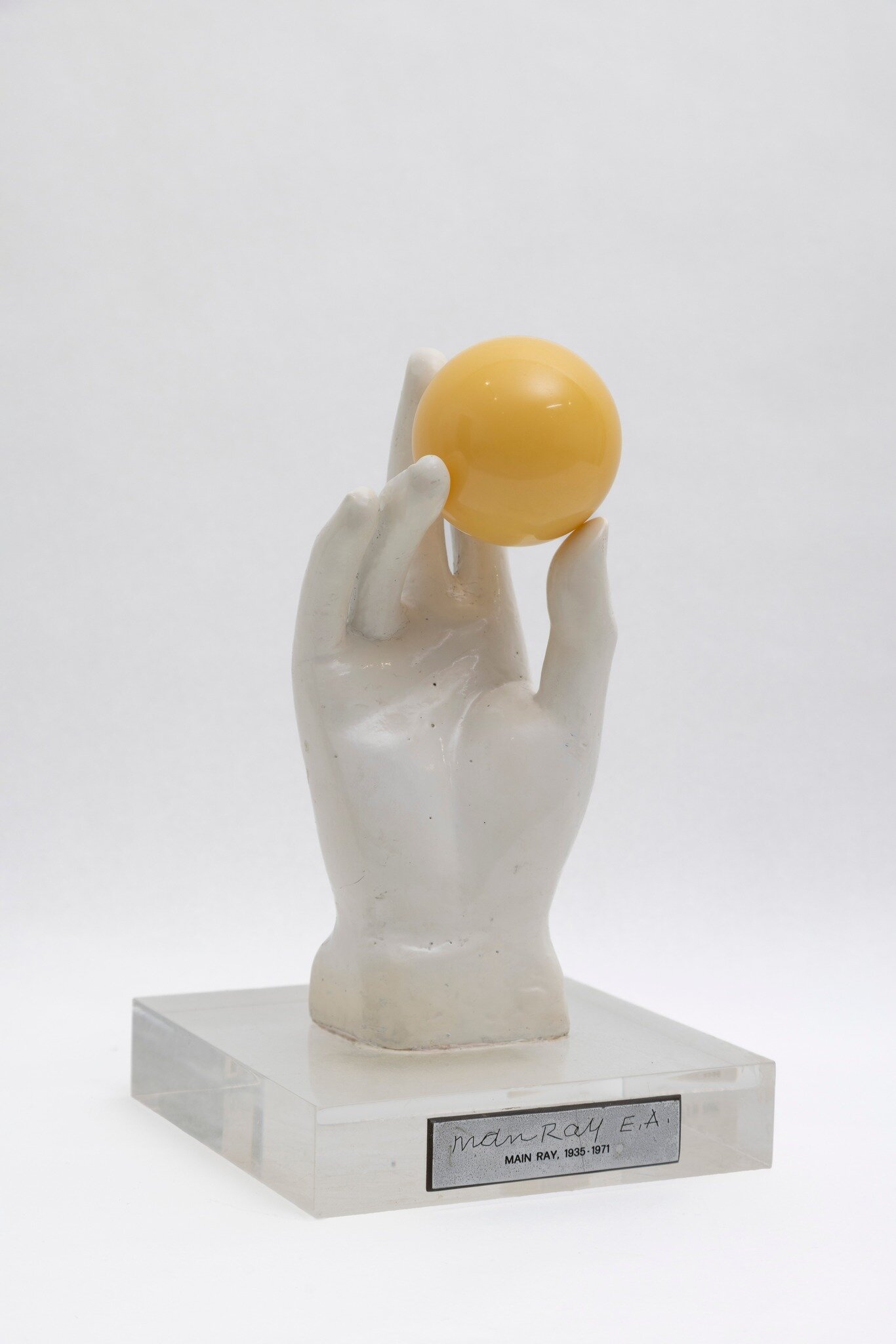
Nel cuore di Milano, tra gli spazi della Fondazione Marconi e della Gió Marconi, prende forma una mostra che non è soltanto una retrospettiva, ma quasi un viaggio dentro la mente di uno degli artisti più irrequieti e visionari del Novecento: Man Ray.
La rassegna “Man Ray: M for Dictionary”, curata dallo storico dell’arte Yuval Etgar insieme a Deborah D’Ippolito, arriva a cinquant’anni dalla scomparsa dell’artista e propone una chiave di lettura sorprendente: il linguaggio come filo rosso dell’intera opera di Man Ray.
Perché, prima ancora di essere fotografo, pittore o inventore di oggetti impossibili, Man Ray è stato soprattutto un autore di idee. E molte di queste idee nascevano proprio dalle parole.
Il vero nome dell’artista era Emmanuel Radnitzky. Nato a Philadelphia nel 1890 da genitori ebrei russi emigrati negli Stati Uniti, decise molto presto di reinventarsi. Cambiò il proprio nome in Man Ray – una trasformazione quasi enigmistica, che conserva tracce dell’identità originaria ma la trasfigura.
Quel gesto non fu soltanto una scelta personale. Fu il primo atto creativo.
Da quel momento, il linguaggio diventa per lui materia viva: parole che si piegano, si deformano, diventano immagini. Non è un caso che la mostra milanese assuma la forma ideale di un dizionario visivo, dove ogni opera sembra funzionare come una voce da esplorare.
Disegni, fotografie, oggetti, dipinti: tutto dialoga con la dimensione linguistica. E tutto suggerisce che tra parola e immagine esiste uno spazio fertile, fatto di ambiguità, ironia e intuizione.
Un protagonista delle avanguardie
La traiettoria artistica di Man Ray attraversa alcune delle stagioni più rivoluzionarie del Novecento. A New York entra in contatto con l’ambiente d’avanguardia e stringe un sodalizio decisivo con Marcel Duchamp, il padre dei ready-made.
È proprio accanto a Duchamp che Man Ray inizia a guardare gli oggetti quotidiani con occhi nuovi, trasformandoli in strumenti poetici.
Nel 1921 si trasferisce a Parigi, allora capitale dell’arte europea. Qui diventa rapidamente il fotografo di riferimento della cerchia surrealista: ritrae scrittori, artisti e intellettuali, costruendo immagini che oggi sono entrate nell’immaginario del XX secolo.
Davanti al suo obiettivo passano figure come Pablo Picasso, Gertrude Stein, Ernest Hemingway, Jean Cocteau e Salvador Dalí. Ma il suo interesse non è mai puramente documentario: ogni fotografia è un esperimento, un modo per interrogare il desiderio, il sogno e l’inconscio.
Un alfabeto per adulti
Il cuore concettuale della mostra milanese è il ciclo “Alphabet for Adults”, un progetto in cui ogni lettera dell’alfabeto si accompagna a un’immagine e a una parola: “D” per delight, “R” per regret o real.
Un gioco, certo. Ma anche un esperimento poetico sulla densità del linguaggio.
Man Ray lo spiegava con una frase che suona quasi come un manifesto: creare un nuovo alfabeto a partire dai resti di una conversazione può aprire possibilità inattese nel linguaggio.
Non sorprende quindi che il percorso espositivo si articoli in sezioni dal titolo quasi narrativo: The Alphabet, Light Writing, Body Language, Objectives, Mathematical Objects. Ogni capitolo mette in scena una diversa relazione tra parola, corpo, luce e oggetto.
Un’eredità ancora viva
Accanto alla retrospettiva, la mostra propone anche un secondo progetto, “In Other Words”, in cui alcuni artisti contemporanei dialogano con l’eredità di Man Ray.
Tra loro figurano Alex Da Corte, Simon Fujiwara, Wade Guyton, Allison Katz e Tai Shani: autori che, ciascuno a modo proprio, continuano a interrogarsi sul potere del linguaggio nella creazione visiva.
È la prova che Man Ray non appartiene soltanto alla storia delle avanguardie. La sua influenza continua a vibrare nell’arte contemporanea, proprio perché il suo lavoro non si è mai fermato a una tecnica o a uno stile.
L’enigma di Man Ray
Quando morì nel 1976 a Parigi, sulla sua tomba nel cimitero di Montparnasse fu inciso un epitaffio che sembra riassumere perfettamente il suo spirito:
“Incurante, ma non indifferente.”
Una frase semplice, ma piena di ambiguità — proprio come le sue opere.
Ed è forse questo il modo migliore per avvicinarsi alla mostra milanese: non cercando definizioni definitive, ma lasciandosi guidare dalla curiosità.
Perché, come dimostra l’universo di Man Ray, tra una parola e un’immagine esiste sempre uno spazio di libertà in cui può nascere qualcosa di inatteso.
Man Ray: M for Dictionary
Milano, 11 aprile – 24 luglio 2026
INFO
Gió Marconi
Via Tadino 15, 20124 Milano
T. +39 02 29404373
E. info@giomarconi.com
www.giomarconi.com
Man Ray: When Language Becomes Image
In the heart of Milan, within the spaces of Fondazione Marconi and Gió Marconi, a new exhibition takes shape—one that is not merely a retrospective, but almost a journey into the mind of one of the most restless and visionary artists of the twentieth century: Man Ray.
The exhibition “Man Ray: M for Dictionary,” curated by art historian Yuval Etgar together with Deborah D’Ippolito, arrives fifty years after the artist’s death and offers a surprising interpretative key: language as the guiding thread throughout Man Ray’s entire body of work.
Because before being a photographer, painter or inventor of impossible objects, Man Ray was above all a creator of ideas. And many of those ideas were born from words.
The artist’s real name was Emmanuel Radnitzky. Born in Philadelphia in 1890 to Russian Jewish immigrant parents, he soon decided to reinvent himself. He changed his name to Man Ray—a transformation that resembles a linguistic puzzle, preserving traces of his original identity while simultaneously reshaping it.
That gesture was not merely a personal choice. It was the first creative act.
From that moment on, language became a living material for him: words bend, transform and turn into images. It is no coincidence that the Milan exhibition takes the ideal form of a visual dictionary, where each work appears almost like an entry waiting to be explored.
Drawings, photographs, objects and paintings all engage with the linguistic dimension. Together they suggest that between word and image there exists a fertile space made of ambiguity, irony and intuition.
A Protagonist of the Avant-Garde
Man Ray’s artistic journey moves through some of the most revolutionary moments of the twentieth century. In New York he came into contact with the avant-garde milieu and formed a decisive partnership with Marcel Duchamp, the father of the ready-made.
It was alongside Duchamp that Man Ray began to look at everyday objects with new eyes, transforming them into poetic instruments.
In 1921 he moved to Paris, then the capital of the European avant-garde. There he quickly became the portrait photographer of the Surrealist circle, capturing writers, artists and intellectuals in images that would later become part of the visual imagination of the twentieth century.
In front of his camera stood figures such as Pablo Picasso, Gertrude Stein, Ernest Hemingway, Jean Cocteau and Salvador Dalí. Yet his interest was never purely documentary: each photograph was an experiment, a way to explore desire, dreams and the unconscious.
An Alphabet for Adults
At the conceptual core of the Milan exhibition lies the series “Alphabet for Adults,” a project in which each letter of the alphabet is paired with an image and a word: “D” for delight, “R” for regret or real.
A game, certainly—but also a poetic experiment on the density of language.
Man Ray himself explained it with a phrase that sounds almost like a manifesto: creating a new alphabet from the remnants of a conversation may open unexpected possibilities in language.
It is therefore no surprise that the exhibition unfolds through sections with almost narrative titles: The Alphabet, Light Writing, Body Language, Objectives, and Mathematical Objects. Each chapter stages a different relationship between word, body, light and object.
A Living Legacy
Alongside the retrospective, the exhibition also includes a second project, “In Other Words,” in which contemporary artists engage in dialogue with Man Ray’s legacy.
Among them are Alex Da Corte, Simon Fujiwara, Wade Guyton, Allison Katz and Tai Shani—artists who, each in their own way, continue to question the power of language within visual creation.
It is proof that Man Ray does not belong solely to the history of the avant-garde. His influence continues to resonate in contemporary art precisely because his work was never confined to a single technique or style.
The Enigma of Man Ray
When he died in 1976 in Paris, an epitaph was engraved on his grave at the Montparnasse Cemetery that seems to perfectly capture his spirit:
“Unconcerned, but not indifferent.”
A simple sentence, yet full of ambiguity—just like his works.
Perhaps this is the best way to approach the Milan exhibition: not by seeking definitive definitions, but by allowing curiosity to guide us.
Because, as Man Ray’s universe shows, between a word and an image there is always a space of freedom where something unexpected can emerge.
Captions
Man Ray
Main Ray, 1935-1971
Bronzo dipinto e palla da biliardo in avorio su una base di plexiglass
Painted bronze, ivory billiard ball on plexiglass base
Edition of 10, Galleria Schwarz, Milan 1971
23.5 x 14.6 x 14.6 cm
© Man Ray 2015 Trust, by SIAE 2026
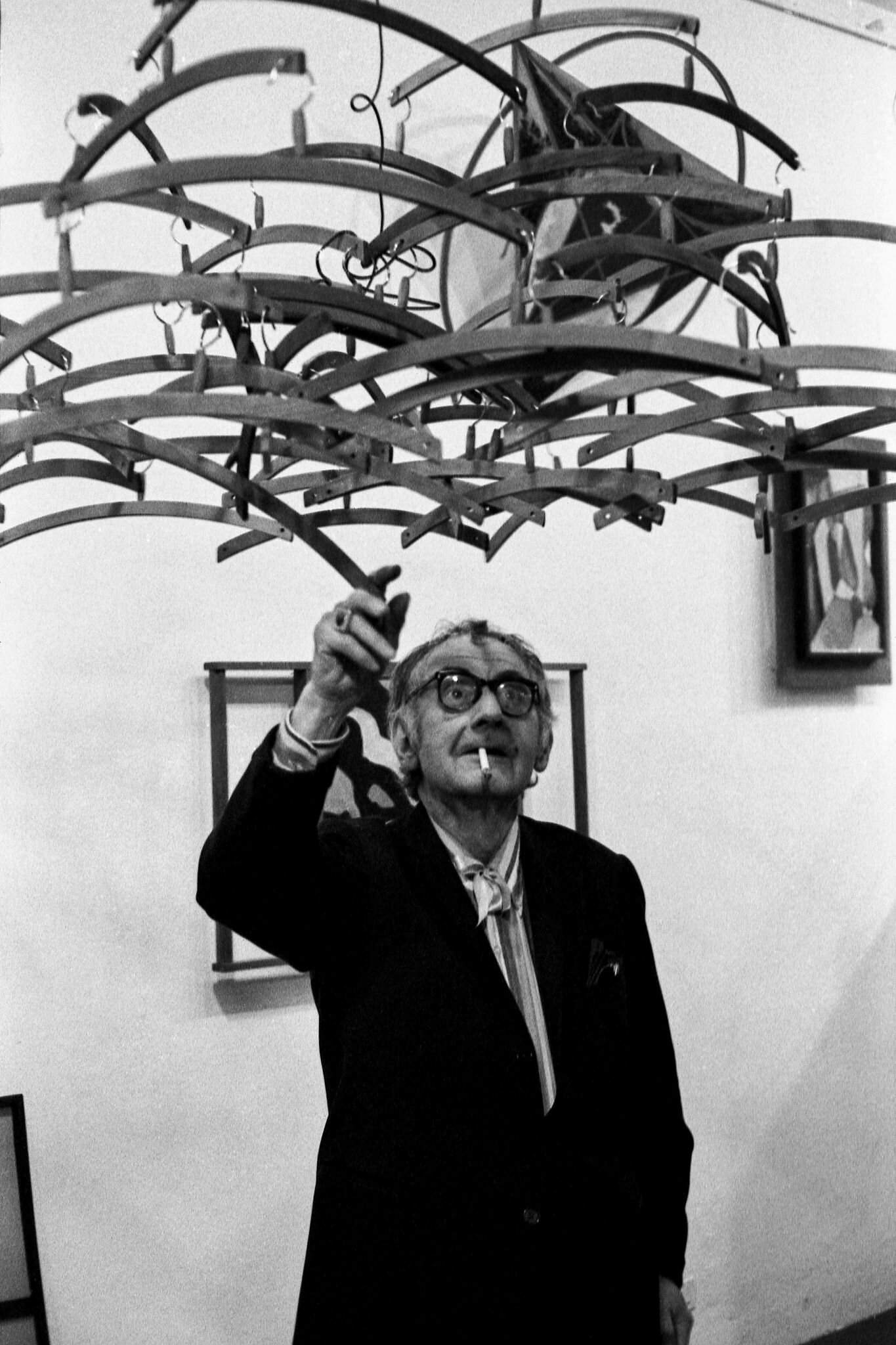
Man Ray all’opening della mostra Je n’ai jamais peint un tableau récent, Studio Marconi, Milano 1969 foto di Enrico Cattaneo